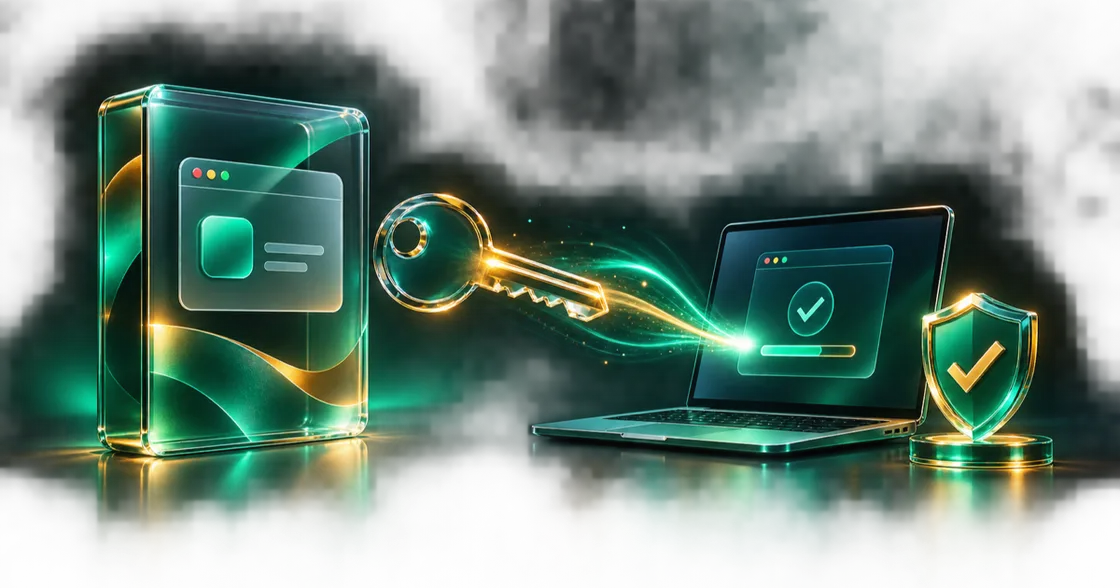
How to Sell Software License Keys More Securely
A practical trust model for selling licensed software: artifact integrity, policy snapshots, activation seats, offline access, and honest DRM expectations.
Billixi Editorial
Marketplace education team

Direct answer
Treat licensing as an evidence chain, not a secret string. Bind each purchase to a clear policy, deliver only approved artifacts, enforce seats on the server, rotate refresh credentials, and accept that client-side DRM raises the cost of abuse but cannot make software unbreakable.
A license key is only an identifier. By itself, it cannot confirm that the purchase is still valid, the buyer received the approved file, or the current device is allowed to run it.
This article covers the security model. For product packaging, pricing, product-page content, private delivery, and the buyer journey, begin with how to sell software licenses online and the dedicated software-license solution.
For most sellers, the practical rule is simple: define the license terms, deliver only approved releases, let the server control device limits, and give buyers a clear way to manage their installations. The sections marked For developers explain the technical controls behind that workflow.
Build an evidence chain
A trustworthy licensed purchase should connect:
- The product and selected plan
- The policy shown at purchase time
- The current payment or refund state
- The exact approved release
- The issued license entitlement
- The installations consuming available seats
- Every activation, deactivation, refund, expiry, and revocation event
When one part is unclear, pause delivery or access until it can be checked. This protects the buyer as well as the seller. Billixi explains the visible buyer and seller signals in the license trust and badges guide.
Freeze the policy at purchase
Publishers may improve their license rules over time, but existing buyers need predictable terms. Save the exact policy that applied to each purchase.
Useful policy fields include:
| Policy field | What it controls |
|---|---|
| Seat limit | Number of concurrent installations |
| Offline window | How long an issued entitlement can work without the server |
| Update policy | Which product versions the buyer may use |
| Feature keys | Capabilities included in the purchased plan |
| Subscription end | When time-limited access expires |
Changing the current product policy should affect new purchases. It should not silently rewrite the agreement attached to old ones.
Approve the exact artifact
Do not assume a file is safe and correct because its name or extension looks right. A stronger release process:
- Stores the original file privately
- Checks the file hash and size
- Detects the real file type
- Scans archives without executing them
- Records which scanner and rules were used
- Promotes only the exact approved release
- Preserves enough evidence to explain the decision
The buyer's download must point to that exact approved release. For an overview of the available license workflows, see the Billixi license help center.
Make the server authoritative for seats
The app may request activation, but the server should decide whether a device slot is available. Otherwise, a modified copy of the app could approve itself.
Create a random installation ID and keep it in the operating system's secure storage. Avoid MAC addresses, disk serials, and browser fingerprints; they are unreliable and create unnecessary privacy risk.
For developers: the activation service should:
- Verify the license, product, purchase, policy, and release.
- Protect the installation identifier.
- Check the server-side seat count.
- Record the installation and the decision.
- Return time-limited proof of access and a protected renewal credential.
The Activation v2 integration guide contains the implementation details and expected request flow.
Rotate refresh credentials
For developers: long-lived access tokens are difficult to contain after theft. Prefer one-time credential rotation:
- The current refresh credential is consumed once.
- A replacement is returned with the new entitlement.
- The client safely replaces the old credential.
- Reuse of an already-consumed credential is treated as suspicious.
- A compromised credential chain can be blocked without changing every license.
Keep these credentials in Keychain, Keystore, DPAPI, or an equivalent secure facility—not in source code or ordinary settings.
Design offline access honestly
Offline access is a trade-off:
| Short offline window | Long offline window |
|---|---|
| Faster revocation effect | Better resilience during outages |
| More frequent refreshes | Slower response to refunds or compromise |
| Greater dependency on service availability | Longer validity for already-issued tokens |
Offline access usually cannot be revoked before its time limit ends because the app is not contacting the server. Choose a window that fits the product's risk and reliability needs, and explain it on the product page.
Validate signed entitlements strictly
For developers: when using signed proof of access:
- Allow only the expected algorithm.
- Select the key by
kid. - Verify signature, issuer, audience,
nbf, andexp. - Cache public keys according to response headers.
- Refresh the key set once for an unknown
kid. - Fail closed when verification cannot be completed.
Public verification keys can be distributed. Private signing keys must never be included in the client application. Follow the exact validation flow in the Activation v2 integration guide.
Know what DRM cannot do
Any control installed on a buyer's device can eventually be modified by a determined attacker. Licensing is still useful: it supports legitimate customers, limits casual sharing, manages device access, and raises the cost of abuse.
Do not market a client-side activation system as “unbreakable.” A more credible promise is:
Purchases, approved releases, device limits, and access decisions are controlled and recorded by the server.
Publisher checklist
Before selling licensed software:
- Define a versioned purchase policy.
- Upload releases through an integrity and approval pipeline.
- Keep signing keys outside client and web bundles.
- Use random installation identifiers.
- Enforce seat limits on the server.
- Ask a developer to implement credential rotation and strict signature checks.
- Document offline behavior.
- Connect the refund policy and subscription expiry to the license lifecycle.
- Provide buyers a self-service way to review and deactivate installations.
- Test recovery from lost responses, duplicate requests, and temporary outages.
A secure license system is less about hiding one key and more about keeping the purchase, terms, approved file, and installations connected. Sellers define the promise; the server and client integration enforce it.
Put this guide into practice
Related Billixi solutions
Explore the workflow that matches this guide, including the public offer, delivery context, USDT checkout, and eligible distribution options.