How to Automate Digital Download Delivery After Crypto Payment
Design a reliable path from crypto payment confirmation to private buyer access with clear states, safe retries, and recoverable support.
Billixi Editorial
Marketplace education team

Direct answer
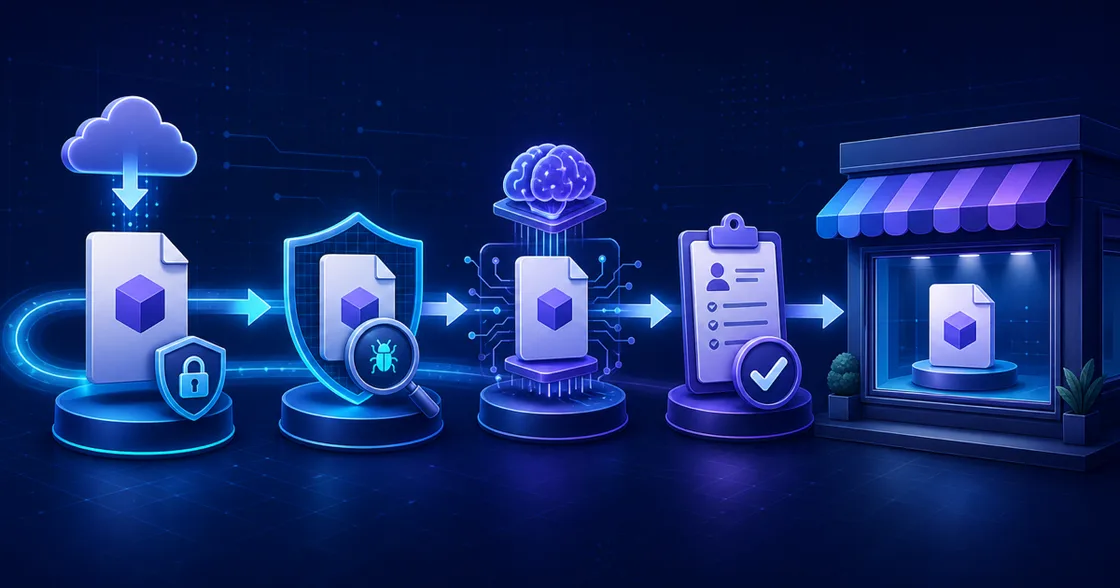
To automate digital download delivery after crypto payment, keep the public listing separate from the private file, create one durable purchase record, wait for the required payment confirmation, grant access idempotently, and let the buyer return through an authenticated library. Retries must converge on the same entitlement instead of charging twice or issuing inconsistent access.
“Automatic delivery” should mean that a confirmed purchase reliably creates the correct private access—not that a public file URL appears after someone visits a payment page. The payment, purchase, entitlement, file release, and buyer-facing status are related but distinct records.
This guide explains the seller-facing model. For the complete product journey, start with how to sell digital products with crypto.
The reliable delivery path
- Publish one canonical public listing with no private file URL.
- Create one checkout intent for the selected product and variant.
- Show the exact token, network, destination, and amount.
- Detect the transaction and apply the required confirmation policy.
- Record the purchase once.
- Grant the matching entitlement once.
- Expose an authorized download or buyer-library entry.
- Retry incomplete fulfillment safely.
- Give support enough state to distinguish payment from delivery failures.
Separate the public listing from private delivery
The public page is meant to be crawlable and shareable. It can include the title, description, preview images, file facts, requirements, license summary, price, and delivery explanation. It must not contain the complete paid file, license key, membership invite, signed buyer URL, or reusable secret. Telegram and Discord membership offers are not available for new Billixi sales; the invite example applies only to fulfillment of existing purchases.
Private delivery should verify the buyer and entitlement at access time. A URL is not private merely because it is long or omitted from navigation. Do not place paid files in a public directory, sitemap, guide Markdown, static page source, or analytics event.
Model explicit states instead of one “paid” flag
| State | What it means | Buyer-facing action |
|---|---|---|
| Checkout created | Payment instructions exist | Pay the displayed amount on the displayed network |
| Payment detected | A candidate transaction was observed | Wait; do not pay again unless instructed |
| Confirming | Required network confidence is not complete | Show progress and a support path |
| Paid | The purchase was accepted | Fulfillment can proceed |
| Access pending | Purchase exists but delivery is not ready | Retry safely; preserve proof of purchase |
| Available | Entitlement and download are ready | Open from the buyer library |
| Access problem | Authorization or artifact state blocks delivery | Diagnose the exact cause without charging again |
| Refunded or revoked | Policy changed the entitlement | Explain the current access state accurately |
“Failed” is too broad when used alone. A payment can be unpaid, underpaid, on the wrong network, unconfirmed, accepted but not fulfilled, or fulfilled while a provider is temporarily unavailable.
Match the exact token, network, and amount
USDT exists on multiple supported protocols. The buyer must see the token and network accepted for that checkout. Do not assume that the symbol alone identifies the transfer path.
Validate the destination, token contract or asset identity, network, amount, transaction uniqueness, and confirmation policy according to the payment provider and marketplace design. Do not turn a screenshot or buyer-supplied transaction hash into automatic proof without verification.
Display USDT as USDT. It may be designed to track a reference value, but it is not the ISO fiat currency USD and it can exist on different networks.
Make purchase creation idempotent
Networks, webhooks, queues, browsers, and workers retry. The same accepted payment event can arrive more than once. A correct system makes repeated processing converge on one purchase and one entitlement.
In practical terms:
- a checkout intent has a durable identifier;
- a verified transaction cannot settle unrelated purchases twice;
- processing the same confirmation again does not duplicate the order;
- granting access again returns the existing entitlement;
- a retry does not create a second charge;
- partial work is recoverable after a crash or provider timeout.
The seller should not need to understand the implementation details, but should test the behavior those controls produce.
Keep the purchase authoritative when delivery is delayed
A digital file service, object store, Membership provider for an existing purchase, or license issuer can be temporarily unavailable. That should not erase an accepted purchase.
The system should preserve payment evidence and move fulfillment through a retryable state. The buyer should see that payment was accepted, whether access is pending or available, and how to get help. Support should be able to identify the product, variant, artifact version, purchase, and fulfillment status without requesting private keys or asking for another payment.
Authorize every download
An authenticated library is a convenient entry point, but the download itself also needs authorization. Common safe patterns include a short-lived signed URL created after entitlement verification or an authorized server stream that checks access before serving bytes.
Controls should reflect the product and risk, including:
- exact product and variant entitlement;
- current artifact release and approval state;
- expiration of temporary download URLs;
- safe filename and content-disposition behavior;
- rate and abuse controls that do not lock out ordinary buyers;
- logs that avoid exposing full signed URLs or secrets.
Virus or artifact review is not a guarantee of absolute safety. The exact file delivered should match the exact release approved through the applicable review process.
Treat variants and updates as real entitlements
If a product has Basic and Pro packages, the buyer should receive the selected variant's files—not every file associated with the product. Store the purchased variant and resolve access from that durable record.
For updates, decide whether the buyer receives:
- only the purchased version;
- corrections to that version;
- updates within the same major edition;
- all future versions;
- updates until a stated date.
The product page, checkout, purchase record, and library should agree.
Design the support view around evidence
Support needs a timeline, not a generic “download does not work” ticket. Useful non-secret evidence includes:
- checkout and purchase identifiers;
- product and purchased variant;
- token, network, expected amount, and verified payment state;
- entitlement state and creation time;
- artifact release/version and availability;
- last fulfillment attempt and safe error category;
- whether the buyer is authenticated as the entitled user.
Never ask a buyer for a seed phrase or private key. Avoid copying sensitive checkout secrets, full signed URLs, or unrelated personal data into tickets.
Test the buyer journey before promotion
Run more than the happy path:
- correct payment reaches available access;
- duplicate payment notifications do not duplicate the purchase;
- refreshing checkout does not change the destination or create confusion;
- delayed confirmation has a clear state;
- temporary file-service failure preserves the paid order and later recovers;
- the buyer can return from a new session and find the purchase;
- a non-buyer cannot use the download route;
- the wrong variant is never substituted;
- a superseded or rejected artifact is not newly delivered;
- refund or access-policy changes produce the intended entitlement state.
Manual versus automated delivery
| Model | Advantage | Main cost or risk | Good fit |
|---|---|---|---|
| Manual email or message | Simple for a tiny validated pilot | Delay, human error, weak repeat access, exposed attachments | Early low-volume testing with clear expectations |
| Automated email link | Fast and familiar | Forwarding, expired links, inbox failure | Low-risk files with authorization behind the link |
| Authenticated buyer library | Durable status and repeat access | More account and entitlement design | Marketplace products and ongoing catalogs |
| Provider-managed entitlement | Can automate existing Membership purchases or licenses | Provider outages and reconciliation | Products whose value lives in the external provider |
Automation is valuable when it makes state more reliable. A fast but unauditable link is not a stronger system than a slower, well-recorded pilot.
Delivery readiness checklist
- The public page contains previews and facts, never the paid file URL.
- Checkout shows the exact token, network, amount, and destination context.
- Payment detection and confirmation are separate visible states.
- Reprocessing the same event does not duplicate purchase or access.
- The purchased variant determines the delivered artifact.
- Paid orders survive temporary fulfillment outages.
- Download authorization is checked at access time.
- The buyer can return through an authenticated library.
- Support can distinguish payment, entitlement, artifact, and provider problems.
- Logs and analytics exclude prompts, personal data, payment secrets, and signed URLs.
- Refund and support handling align with the current refund policy.
Frequently asked questions
How many confirmations should a crypto payment require?
There is no universal number for every network, token, amount, and risk model. Use the current policy of the payment system and explain the confirming state without promising an exact time you cannot guarantee.
Can I redirect directly to the file after payment?
Only if access is authorized and recoverable. A public or reusable file URL is not safe delivery, and a redirect alone does not create a durable buyer entitlement.
What does idempotent delivery mean?
It means retrying the same operation produces the same intended purchase and access result rather than duplicates or conflicting state.
What if the buyer sends USDT on the wrong network?
Do not automatically mark it paid merely because the symbol and amount look similar. Follow the platform's support and recovery policy; recovery may be impossible or require operator review.
Should the buyer pay again when delivery fails?
Not for the same accepted purchase. Preserve the purchase, retry fulfillment, and give support the evidence needed to restore the correct access.
Reliable automation is a chain of evidence: canonical offer, exact payment instruction, verified confirmation, durable purchase, idempotent entitlement, and authorized delivery.
Examples from the live marketplace
Related digital products
Explore up to three currently public products that match this guide. Prices come from the live catalog.

2027 Minimal Life Planner | 30-Page Printable PDF
5.99 USDTA live downloadable offer that connects a public listing to private buyer access.

VortexAI — Dark Mode AI SaaS & Startup Landing Page Template
25 USDTA live downloadable offer that connects a public listing to private buyer access.

Local SEO Starter Kit: Google Maps Audit & Client Guide (Arabic)
9 USDTA live downloadable offer that connects a public listing to private buyer access.
Put this guide into practice
Related Billixi solutions
Explore the workflow that matches this guide, including the public offer, delivery context, USDT checkout, and eligible distribution options.